 Robert Ambrogi Blog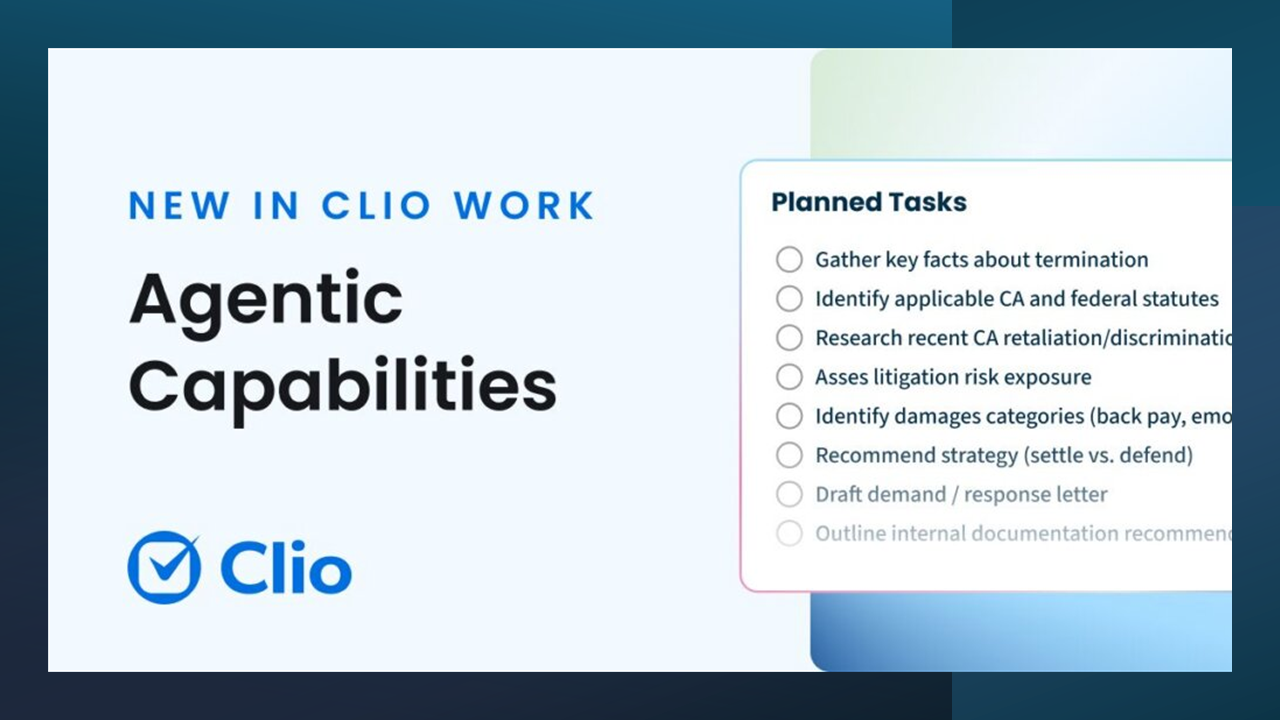


Clio today announced two notable updates to its AI product line: the addition of agentic capabilities to Clio Work, and the launch of a standalone Vincent by Clio mobile app for iOS and Android.
Agentic Clio Work
When Clio CEO Jack Newton unveiled Clio Work at ClioCon last October — in a keynote that left attendees variously shell-shocked, thrilled and overwhelmed — he described it as the realization of Clio’s vision for an “intelligent legal work platform” that would dissolve the traditional boundary between the business and practice of law.
Today’s update extends that vision with the addition of agentic capabilities, enabling Clio Work to handle complex, multi-step legal tasks from a single natural-language prompt.
Rather than requiring users to manage each step individually, Clio says, lawyers can now issue goal-oriented instructions — such as “build a defense strategy” or “find everything that could kill this deal before signing” — and Clio Work determines and executes the sequence of steps needed to accomplish the task.
The agentic capabilities are powered by what Clio calls a “skills infrastructure” — a set of legal-aware capabilities that Clio Work can invoke autonomously depending on what a task requires.
These skills evolved from Clio Work’s existing workflows but no longer require the user to trigger them manually. Clio Work understands the goal, determines which skills are needed, and executes across them in a single, continuous experience.
To keep lawyers in the loop, the company says, Clio Work displays real-time thinking traces so users can see how work is progressing, and can interrupt, redirect, or refine directions mid-task.
“Clio Work’s agentic capabilities allow legal practitioners to delegate complex, multi-step tasks to a truly collaborative AI assistant, without sacrificing control or visibility into workflows,” said John Foreman, Clio’s chief product officer.
Clio says 84 percent of AI queries on the platform are already submitted as freeform, goal-based requests, suggesting that lawyers are naturally inclined to interact with AI the same way they would describe work to a colleague.
The agentic capabilities are applied automatically for all Clio Work users with no setup or configuration required.
Vincent Mobile App
Separately, Clio also announced today the launch of the Vincent by Clio mobile app, which extends Vincent’s legal AI capabilities to iPhone and Android for the first time.
Clio says that the app lets lawyers ask questions, upload and analyze documents, and get answers grounded in cited legal authority — all from their phones. Users can upload complaints, motions, briefs, and transcripts directly from their devices to quickly surface key risks, arguments, and next steps.
For Clio Work subscribers, the mobile app also draws on the full context of a matter — including client communications, deadlines, and case activity — so that analysis reflects what is actually happening in the case. Work started on mobile can be continued on desktop without losing context.
The Vincent by Clio mobile app is available now on iOS and Android.