 Robert Ambrogi Blog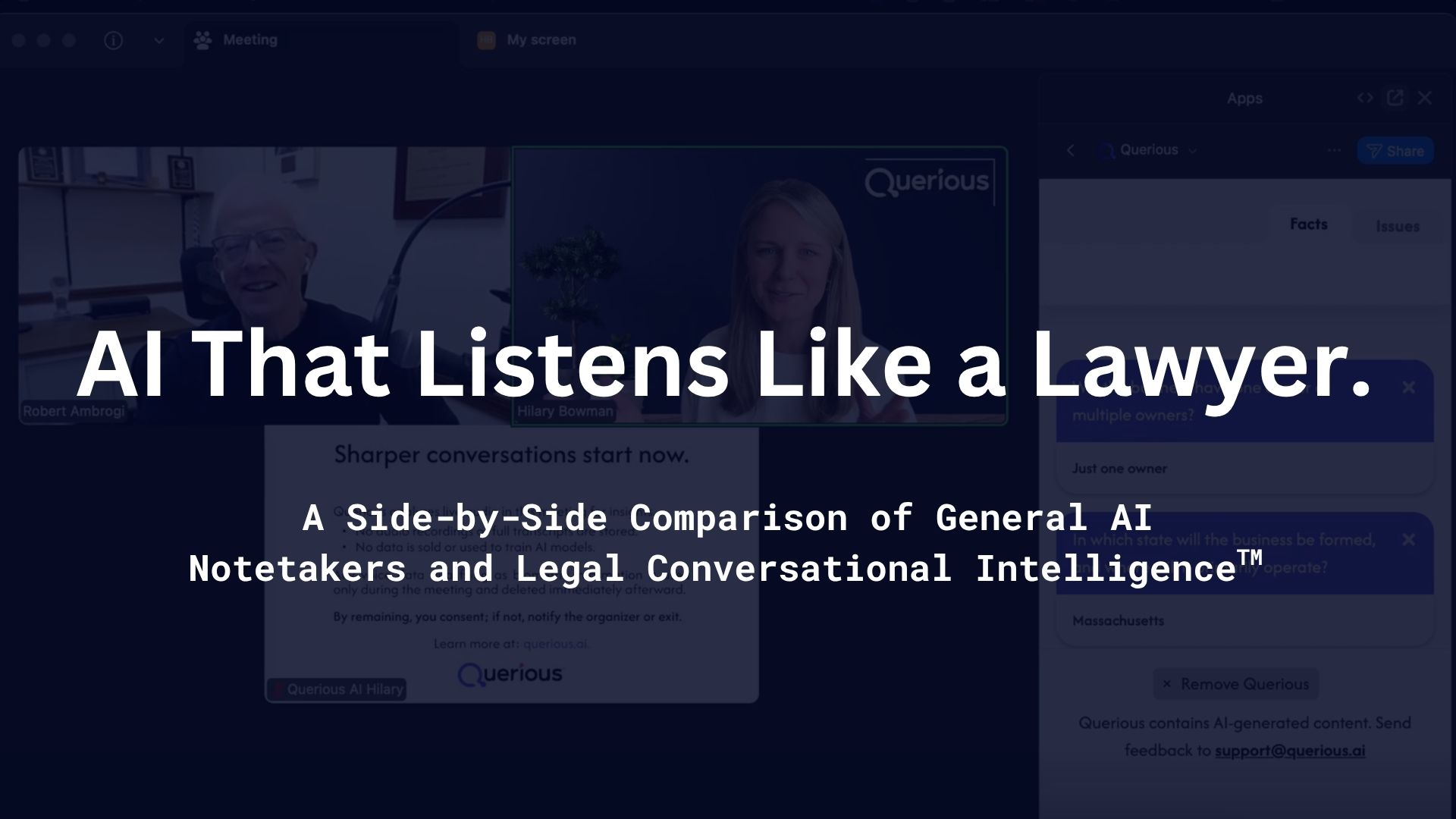


AI That Listens Like a Lawyer: Courts Are Exposing the Gap Between What AI Notetakers Promise and What Their Contracts Permit. Purpose-Built Legal Conversational Intelligenceᵀᴹ Tools, Such as Querious®, Offer Attorneys a Defensible Path Forward.
A gap exists between how general-purpose AI notetakers are marketed to legal professionals and what their terms of service permit. As courts and regulators begin to test that gap, Legal Conversational Intelligenceᵀᴹ platforms, such as Querious®, offer attorneys a defensible alternative built from the ground up to align architecture, contractual terms, and professional obligations.
Hilary Bowman, Querious, CEO & Founder, Author
William Love, Managing Partner of EsqLove, Editor
A. Executive Summary
Attorney-client conversations are critical moments that raise legal issues, uncover factual inconsistencies, and even trigger disclosure obligations. Key words surface in the flow of dialogue and context can be extraordinarily difficult to reconstruct after the conversation.
This reality makes live conversation one of the most valuable and untapped use cases for AI in legal practice. Unlike tools that support research, drafting, and data analysis behind the scenes, AI in a live client conversation is a highly visible application of the technology.
Until recently, attorneys who recognized this opportunity faced an uncomfortable choice: adopt general-purpose AI notetakers that were never designed for the legal profession or go without. Today, a new category of purpose-built technology, Legal Conversational Intelligence™, offers attorneys a third path that is designed to advance both productivity and professional responsibility through real-time insights during a conversation and secure note-taking after the conversation.
The following is a side-by-side analysis of these two categories of tools from functional, design, contractual, legal, and ethical perspectives.
B. Analysis
1. What is the purpose of the product?
General-purpose AI notetakers are designed to capture everything that happens in a conversation. Tools like Otter.ai, Fireflies.ai, Fathom, and Granola automatically join scheduled meetings, record audio and video,¹ generate real-time transcripts, and produce post-meeting summaries. They are inexpensive, require no prompting, and integrate with Zoom, Microsoft Teams, and Google Meet. For professionals outside of law, these tools deliver meaningful productivity gains. For attorneys, they raise questions about privilege, consent, confidentiality, and biometric privacy that the tools were not designed to address.
Querious is the first Legal Conversational Intelligenceᵀᴹ tool. During a conversation, Querious accesses audio in real-time, analyzes it, and delivers to attorneys real-time insights about potential legal issues, follow-up questions, and relevant legal content. After the conversation, Querious generates a summary email and detailed notes, including a draft billing entry. Querious is on par with the cost of general-purpose AI notetakers. The product integrates into all major virtual meeting platforms, as well as legal-specific practice management tools such as Clio and Smokeball. Whether it’s an intake, advisory or strategic conversation, this product opens up new possibilities for attorneys to brainstorm and capture critical details in real-time during every key legal conversation.
2. How is the product built?
General-purpose AI notetakers typically create and store full audio recordings and transcripts on the vendor’s cloud infrastructure, often indefinitely by default. Deleted content may remain in a trash folder for weeks before permanent removal.² When speaker recognition features are used to distinguish between participants (a process known as speaker diarization), the resulting voice-derived data may constitute biometric identifiers under state privacy laws.³
Querious processes meeting audio and by default, filters personally identifiable information (“PII”) such as names, phone numbers, and identification numbers, before the content reaches an AI model.⁴ The conversational data is then analyzed by a handful of privately deployed LLMs.⁵ Querious neither creates, nor stores, complete audio files or verbatim transcripts of the conversation.⁶ Any interim speaker diarization is deleted upon conclusion of the conversation.⁷ After a conversation ends, Querious generates the post-meeting summaries and billing entries. Any partial audio or transcript files created during the analysis process is deleted. By default, the attorney’s summaries are retained for sixty days, unless the attorney sets a shorter time period in their profile.⁸
3. Can the product use my conversational data to train AI?
At least one major vendor of a general purpose AI notetaker explicitly reserves the right to use machine learning on user content and usage data for testing, tuning, and improving its algorithms.⁹ Others grant themselves licenses to use de-identified or aggregated customer data to train and improve their products.¹⁰ These permissions are often buried in dense contractual language that bears little resemblance to the vendor’s marketing, which typically emphasizes privacy and security.
The claim that data is “de-identified” before training deserves scrutiny. Vendors rarely offer technical explanations of how de-identification takes place. Both courts and regulators have grown skeptical of such assurances. For example, the FTC has taken an aggressive position on “hashing,” which is a method that “us[es] math to turn [personal data] into a number (called a hash) in a consistent way.”¹¹ The FTC warned that “hashes aren’t ‘anonymous’” and “staff will remain vigilant to ensure companies are following the law and take action when the privacy claims they make are deceptive.”¹²
Querious’s architecture differs in several respects. The terms of service certify that production and training data pipelines are physically and logically separated at the network level.¹³ Thus, it is technically impossible for client communications to enter training pipelines.¹⁴ Querious uses privately deployed AI model instances that are isolated from the public internet.¹⁵ As a result, the conversational data is never routed to publicly accessible AI platforms. Querious’s agreements with third-party AI providers contractually prohibit those providers from using client data for training and require processing through private, isolated instances.¹⁶
4. Does the product support compliance with wire-tapping laws?
General-purpose AI notetakers that record meeting audio may expose attorneys to liability under federal and state wiretapping statutes.¹⁷ Fifteen states require all-party consent to record a conversation, including California, Florida, Illinois, Massachusetts, and Pennsylvania.¹⁸ If any meeting participant is located in an all-party consent jurisdiction, that state’s law may apply and an AI tool that records by default, without prompting the host to obtain consent from each participant, could trigger liability for the attorney who enabled it.
In contrast, Querious’s default settings are designed to support compliance with all-party consent requirements. For example, when Querious joins a virtual meeting, the default bot image visible to every participant in the meeting clearly states that the tool is being used to analyze audio and if you do not consent to the meeting, to tell the organizer to remove it or exit the meeting. A similar default text message is pushed to the meeting chat visible to all participants with a similar message regarding consent. Querious also enables users to customize the bot image, including adding their own logo and editing the disclaimer language to meet their specific needs and risk tolerance. Similarly, Querious and its “instant meeting” feature runs off a device during an in-person meeting, the attorney cannot start the audio analysis and note-taking process until the attorney has checked a box acknowledging that all participants in the conversation have been informed that Querious is being used and the participants have consented to its use.
5. Does the product support compliance with biometric privacy laws?
General-purpose AI notetakers that distinguish between speakers by analyzing vocal characteristics face growing exposure under state biometric privacy laws. In Cruz v. Fireflies.AI Corp. and Basich v. Microsoft Corp., plaintiffs allege that speaker diarization creates voiceprints without the written notice, informed consent, or publicly available retention and destruction policy the statute requires.¹⁹ With the Illinois Biometric Privacy Act having statutory damages of $1,000 to $5,000 per violation and over twenty additional states now classifying biometric data as sensitive personal information, the compliance landscape extends well beyond Illinois.²⁰
Querious addresses biometric privacy compliance directly in its architecture, terms of service and dedicated compliance documents.²¹ From an architecture perspective, Querious by default does not distinguish between speakers and it automatically applies a personally identifiable information (“PII”) filter that removes names, phone numbers, identification numbers etc. from the conversation data before privately deployed LLMs analyze it.²² When speaker diarization is enabled, Querious analyzes voice characteristics to cluster audio segments by speaker. Speaker labels in the output are derived from the meeting platform’s participant metadata, not from biometric identification. Querious does not create a mapping between voice characteristic data and participant identity. Once a conversation ends, this ephemeral speaker-differentiation data is deleted and does not persist as a voiceprint that is created, stored, or carried across conversations.
Even if the analysis of conversational data by Querious would constitute biometric data (i.e., a voiceprint) and implicate certain state privacy laws, Querious reminds the attorney to collect consent from all participants of the conversation. Querious maintains a publicly available biometric data retention and destruction policy as required by 740 ILCS 14/15(a)²³ and supports attorneys in achieving their consent collection through compliance resources in the platform.
6. Does the product support an attorney’s ethical obligation to keep client information confidential?
Under Model Rule 1.6 and analogous adopted rules, attorneys must make reasonable efforts to prevent unauthorized disclosure of client information.²⁴
When an attorney enables a general-purpose AI notetaker, sensitive client communications are transmitted to a vendor’s cloud infrastructure where they may be stored indefinitely, used to train AI models, or made accessible in ways that the attorney cannot control. The “reasonable efforts” framework of Model Rule 1.6 requires attorneys to assess the sensitivity of the data, the likelihood of disclosure, and their ability to evaluate a vendor’s security practices. The default settings of many general-purpose AI notetakers present a difficult case for compliance.
Querious does not require attorneys to configure their way to compliance. Privacy protections are embedded in the platform’s features and default settings. An attorney evaluating Querious using the “reasonable efforts” framework would find numerous features to support or even exceed such a conclusion, including the PII filter, privately deployed LLMs, and ephemeral access to partial audio and transcript files of the conversation. Furthermore, the approach taken by Querious has been validated through its successful completion of SOC2 Type II certification and integrations with Microsoft Teams, Zoom, Google Meet, legal practice management tools, as well as a legal malpractice insurance carrier.
7. Does the product preserve an attorney-client privilege and create documentation covered by work product doctrine?
In United States v. Heppner, the first federal decision to address privilege and work product claims involving AI platforms, Judge Rakoff held that a client sharing communications from his counsel with a consumer AI platform’s terms permitting data collection, model training, and third-party disclosure destroyed any reasonable expectation of privacy required to claim protection under attorney-client privilege or work product doctrine. If the court’s reasoning was applied to general-purpose AI notetakers, a vendor’s terms that permit it to retain, use, or disclose privileged communications, would likely not rise to level of privacy necessary to sustain attorney-client privilege for the conversation or protect the resulting notes under the work product doctrine.²⁵
Notably, however, Judge Rakoff observed that the outcome might differ with an enterprise-grade tool featuring contractual confidentiality protections, prohibitions on data training, or zero-retention policies.²⁶ All of these features are built into the architecture of Querious.
Querious’s real-time features also strengthen the legal protections available for the resulting notes and summaries given that it takes direction from the attorney throughout the conversation. Unlike a general-purpose AI notetaker that produces a verbatim transcript (i.e., a mechanical reproduction of a conversation that is difficult to characterize as anything other than a record of the communication itself), Querious generates legal issue identification, suggested questions, and structured summaries that are shaped by and responsive to the attorney’s conversation, interaction with real-time prompts, and representation of a client. Thus, the outputs are more readily characterized as materials prepared to further enhance legal services, supporting protection under the work product doctrine as materials reflecting the attorney’s legal judgment and impressions rather than a passive recording of what was said.
Querious’s contractual commitments reinforce this protection at every stage. The terms of service establish that Querious operates as a specialized technology agent under the attorney’s direction and control, with a relationship “analogous to that of a paralegal, court reporter, or litigation support vendor,” which is language designed to preserve privilege under United States v. Kovel.²⁷ If a subpoena or court order seeks client communications or AI-generated outputs, Querious commits to notifying the affected attorney within 24 hours, asserting privilege on the attorney’s behalf, and declining to produce absent a final court order after exhaustion of available appeals.²⁸ Querious further agrees to cooperate in seeking protective orders under Federal Rule of Evidence 502(d), which allows courts to order that disclosure of privileged information in connection with litigation does not constitute waiver, including providing declarations and technical documentation regarding its ephemeral data handling architecture.²⁹
The result is a layered defense. Privilege protects the underlying attorney-client communications. The work product doctrine independently protects the AI-generated outputs that flow from the attorney’s legal analysis. And the contractual architecture that includes agency relationship, subpoena protocol, and FRE 502(d) cooperation, provides the procedural infrastructure to assert and defend both protections if they are ever challenged.
C. Conclusion
The question is no longer whether AI belongs in attorney-client conversations. It is whether the tools attorneys choose are built to operate within the legal and ethical requirements that govern those conversations. As the above analysis demonstrates, the answer depends not on what a vendor promises in its marketing, but on what its product architecture and terms of service permit.
General-purpose AI notetakers and Legal Conversational Intelligenceᵀᴹ tools may appear to overlap in some functionality, but they diverge on every dimension that matters to a practicing attorney: what data is retained and for how long, whether client communications are used to train AI models, how consent obligations are supported, whether confidentiality is preserved by default or by configuration, and whether the resulting outputs are positioned to withstand scrutiny under both the attorney-client privilege and the work product doctrine.
The legal landscape is moving quickly. Consolidated class actions against AI notetaker vendors are testing wiretapping, biometric privacy, and data training theories in federal court. The first federal decision on AI, work product, and privilege in United States v. Heppner has drawn a clear line between consumer-grade tools whose terms undermine confidentiality and enterprise-grade tools whose architecture preserves it. Attorneys who adopt AI meeting tools without conducting due diligence on architecture, terms, and compliance features are not just accepting productivity tradeoffs, they are accepting legal exposure that is quantifiable, growing, and increasingly tested in litigation.
Querious, as the first Legal Conversational Intelligenceᵀᴹ tool, was built to give attorneys a defensible answer to each of these challenges, specifically through the support of product architecture, contractual commitments, and compliance features that align with the rules of professional conduct. Every architectural claim is reflected in an enforceable contractual provision. Every privacy protection operates by default. And the platform’s real-time legal insights create outputs that strengthen both privilege and work product protections in ways that a verbatim transcript never could. The technology has arrived. The legal frameworks are clear. The only question is whether the tool you bring into your next client conversation was built to meet them.
 Hilary Bowman is the Founder and CEO of Querious, the first Legal Conversational Intelligenceᵀᴹ platform. (Visit www.querious.ai to start a 2-week free trial). She previously served as in-house counsel at Redesign Health and IBM Watson Health through its 2022 divestiture. Hilary began her career as a healthcare attorney at K&L Gates and Womble Bond Dickinson, and clerked at the U.S. DEA. She holds a J.D. from Case Western Reserve University and a B.A. from Stanford University. Hilary is licensed in North Carolina and Massachusetts.
 William Love, Managing Attorney of EsqLove, an Illinois law firm focused on growth companies, and bluechip companies, where he advises clients on SaaS contracting and privacy; international M&A; asset and talent acquisitions; and the legal risks of emerging technology. As a contract nerd, he has delivered over 150 presentations on technology and AI, managing negotiations and conflict, and developing business opportunities through well-executed legal strategy.
¹ See, e.g., Otter your meetings wherever they happen, Otter.ai, https://otter.ai/transcription (last visited Mar. 16, 2026); How to capture video for your Fireflies meeting?, Fireflies.ai, https://guide.fireflies.ai/articles/1980499609 (last visited Mar. 16, 2026).
² Terms of Service § 9.3, Otter.ai, https://otter.ai/terms-of-service (last visited Mar. 16, 2026).
³ Compl., Cruz v. Fireflies.AI Corp., No. 3:25-cv-03399-SEM-DJQ (C.D. Ill. Dec. 18, 2025), available at https://commlawgroup.com/wp-content/uploads/2025/12/Fireflies.ai-Complaint-1.pdf; Compl., Basich v. Microsoft Corp., No. 2:26-cv-00422 (W.D. Wash. Feb. 5, 2026), available at https://www.classaction.org/media/mircosoft-teams-bipa-complaint.pdf.
⁴ Terms of Service § 3.31(b), Querious.ai, http://app.querious.ai/terms-of-service (last visited Mar. 23, 2026).
⁵ Id. § 3.3.
⁶ Id. § 3.4.
⁷ Id.
⁸ Id.
⁹ Terms of Service §§ 9.9, 18.4, Otter.ai, https://otter.ai/terms-of-service (last visited Mar. 16, 2026).
¹⁰ See, e.g., Terms of Service, Section 4: Your Data, Training AI, Fathom.ai, https://www.fathom.ai/terms (last visited Mar. 16, 2026) (enabling the vendor to use deidentified User Content to train its proprietary model); Granola Platform Terms § 6.2.2, Granola.ai, https://www.granola.ai/static/Granola-Platform-Terms-2025-12-19.pdf (granting vendor license to use and access Customer Data to create aggregated and de-identified data to improve, test, train, and operate Granola’s products and services).
¹¹ No, hashing still doesn’t make your data anonymous, FTC.gov (July 24, 2024), https://www.ftc.gov/policy/advocacy-research/tech-at-ftc/2024/07/no-hashing-still-doesnt-make-your-data-anonymous.
¹² Id.
¹³ Terms of Service § 3.2, Querious.ai, http://app.querious.ai/terms-of-service (last visited Mar. 23, 2026).
¹⁴ Id.
¹⁵ Id. § 3.3.
¹⁶ Id.
¹⁷ Compl., Brewer v. Otter.ai, Inc., No. 5:25-cv-06911-EKL, Class Action Complaint (N.D. Cal. filed Aug. 15, 2025), available at https://www.fisherphillips.com/a/web/x27EBgcvus2uFdfXMJiyCk/aAQ5CP/brewer-v-otterai.pdf.
¹⁸ Justia, Recording Phone Calls and Conversations: 50-State Survey, https://www.justia.com/50-state-surveys/recording-phone-calls-and-conversations/ (last visited Mar. 16, 2026).
¹⁹ Compl., Cruz v. Fireflies.AI Corp., No. 3:25-cv-03399-SEM-DJQ (C.D. Ill. Dec. 18, 2025), available at https://commlawgroup.com/wp-content/uploads/2025/12/Fireflies.ai-Complaint-1.pdf; Compl., Basich v. Microsoft Corp., No. 2:26-cv-00422 (W.D. Wash. Feb. 5, 2026), available at https://www.classaction.org/media/mircosoft-teams-bipa-complaint.pdf.
²⁰ Illinois Biometric Information Privacy Act, 740 ILCS 14/20.
²¹ Terms of Service § 5.2(c), Querious.ai, http://app.querious.ai/terms-of-service (last visited Mar. 23, 2026).
²² Id. at § 3.1(a-1).
²³ BIPA Policy, Querious.ai, www.querious.ai/bipa-policy (last visited Mar. 23, 2026).
²⁴ Model Rules of Prof’l Conduct r. 1.6, Americanbarg.org, https://www.americanbar.org/groups/professional_responsibility/publications/model_rules_of_professional_conduct/rule_1_6_confidentiality_of_information/ (last visited Mar. 16, 2026).
²⁵ United States v. Heppner, No. 25-cr-00503-JSR, slip op. at 6–8 & n.3 (S.D.N.Y. Feb. 17, 2026), available at https://www.akingump.com/a/web/ssTGsd5NHbtZ1onzXQMTye/1_25-cr-503-27-memorandum.pdf.
²⁶ Id. at 7 (noting that “had counsel directed [the defendant] to use Claude, Claude might arguably be said to have functioned in a manner akin to a highly trained professional who may act as a lawyer’s agent within the protection of the attorney-client privilege”).
²⁷ United States v. Kovel, 296 F.2d 918 (2d Cir. 1961), available at https://law.justia.com/cases/federal/appellate-courts/F2/296/918/131265/; Terms of Service § 2.2, Querious.ai, http://app.querious.ai/terms-of-service (last visited Mar. 23, 2026).
²⁸ Terms of Service § 4, Querious.ai, http://app.querious.ai/terms-of-service (last visited Mar. 23, 2026).
²⁹ Id. §14.8.