 Robert Ambrogi Blog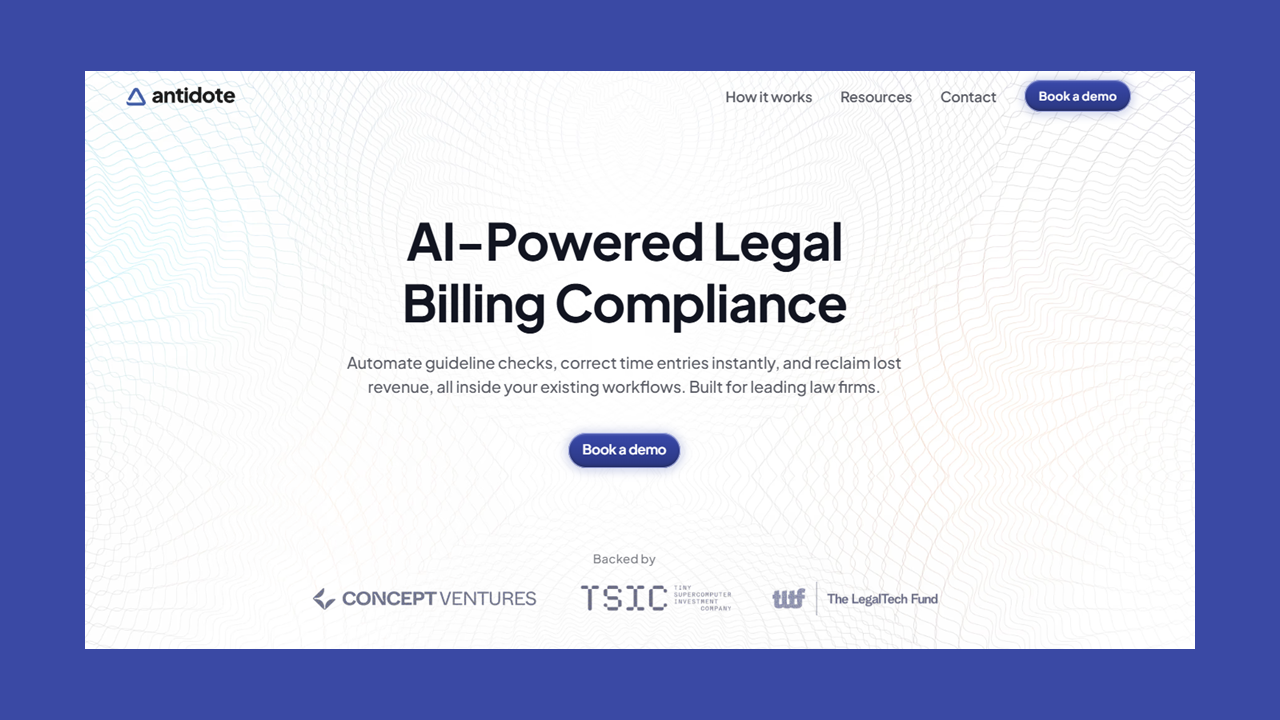


Antidote, an AI-powered billing compliance platform for law firms, announced today it has raised $5 million in seed funding led by Lakestar, with participation from Concept Ventures, The LegalTech Fund, and several unnamed industry angels. The round brings the London-based company’s total funding to $7 million, following a $2 million pre-seed round in 2025.
The funding will accelerate product development and U.S. expansion as Antidote builds on adoption by leading firms across the United States, United Kingdom, and Australia, the company says.
The Billion-Dollar Problem
Antidote was cofounded by CEO Nicholas d’Adhemar, who previously founded and was CEO of Apperio, a spend-management platform for corporate legal, and CTO Matt Lyons, who was chief product and technology officer at Apperio. In May 2025, PERSUIT, a technology company that specializes in outside counsel management for corporate legal departments, acquired Apperio.
In an interview this week, d’Adhemar said that Antidote addresses “one of the biggest sources of revenue leakage inside firms” — the failure to comply with clients’ outside counsel guidelines (OCGs). According to the company, current billing practices and OCG non-compliance lead to 8-12% of billable hours lost to write-offs and rejected invoices every year.
“We built Antidote to remove billing friction by automating compliance for law firms — removing the manual work and shifting compliance upstream, when the work is done, not when you’re trying to send out the bill,” d’Adhemar said.
For context, d’Adhemar notes that AmLaw 200 firms collectively generated approximately $140 billion in revenue in 2024. If those firms are losing even 5% to billing compliance issues, that represents $7 billion in annual revenue leakage across the industry.
The problem stems from law firms’ continued reliance on manual, end-of-month review processes. By the time billing compliance issues are discovered, the work is already done, the time entries are already written, and firms face the choice of either writing off non-compliant time or risking client friction by submitting bills that violate the client’s guidelines.
Real-Time Compliance
Antidote’s core innovation is shifting compliance upstream — catching problems when time entries are created rather than when bills are being finalized. The platform sits on top of a firm’s existing time-recording and practice management systems, automatically reading every time entry and checking it against both client OCGs and internal firm standards.
When the system identifies a potential violation, it flags the entry and provides autocorrected suggestions that are compliant. This happens in real-time, before a bill is ever sent.
The platform uses AI to extract rules from clients’ OCG automatically. These guidelines can be hundreds of pages long and cover everything from prohibited billing practices to specific task code requirements to rate caps and staffing restrictions. Rather than requiring manual rule configuration, Antidote ingests these documents and identifies the relevant compliance requirements.
The platform is designed to work seamlessly within lawyers’ existing workflows, D’Adhemar told me. “We don’t want to create another system lawyers have to learn or another place they have to go.” The platform integrates with major practice management and timekeeping systems used by enterprise law firms.
Beyond Simple Rule-Checking
While Antidote’s core function is identifying OCG violations, d’Adhemar emphasizes that the platform goes deeper than simple rule-matching. The system provides specific, actionable feedback on why a time entry is non-compliant and suggests compliant alternatives.
For example, if a lawyer bills for “research” on a matter where the client’s guidelines prohibit billing for legal research, Antidote won’t just flag it as non-compliant — it will suggest alternative language and approaches that accomplish the same substantive documentation while adhering to the client’s requirements.
This approach addresses a common frustration in law firm billing: the lack of specificity in compliance feedback. Too often, lawyers receive vague guidance about what’s wrong with their time entries without clear direction on how to fix them.
Differentiating from Competitors
Given that Antidote is not the first legal product that aims to solve the problem of compliance with OCGs, I asked d’Adhemar what differentiates Antidote from its competitors. There are several key distinctions, he said.
First is the company’s focus on meeting lawyers where they are rather than forcing them to adopt yet another new tool. While Antidote offers a polished user interface, it can also deliver the same value via email for time-pressed lawyers who don’t want to log into another system.
“Monday morning, Bob, you get an email that would say, ‘Bob, last week you had 21 time entries and we’ve flagged three,'” d’Adhemar explained. Lawyers can accept suggested rewrites directly in the email without ever accessing the platform.
The second major difference stems from Antidote being built post-2022, after the advent of large language models. Unlike incumbents that are retrofitting AI into existing infrastructure, he said, Antidote was designed from the ground up to leverage modern AI capabilities.
In this way, the platform is able to automate rule extraction from OCGs rather than relying on manual configuration. More importantly, it combines document-based rules with historical payment patterns to understand what clients actually pay for in practice, not just what’s written in their guidelines.
This nuanced approach considers the “sentiment” of rules and their real-world applications, he said, rather than treating compliance as a simple binary check.
Unique Mix of Expertise
d’Adhemar brings a unique mix of expertise to addressing the problem of billing compliance. He has experienced the problem from both sides, as a practicing lawyer and as a private equity client of law firms. He has also previously built and scaled legal technology startups, including Apperio, which specifically focused on legal spend management, although from the opposite side of the coin.
“Nicholas brings rare credibility here,” said Navid Meyer, venture partner at Lakestar. “He’s lived the problem as both a lawyer and a private equity client and has already built and scaled legaltech startups into category-defining platforms for legal spend management.”
The company’s early traction — adoption by leading firms across three continents — suggests strong market demand for proactive billing compliance tools. As client pressure on law firm billing practices continues to intensify, products that reduce write-offs while improving client relationships are likely to find receptive audiences in the AmLaw 200 and their international equivalents.
Looking Ahead
With the new funding, d’Adhemar told me, Antidote plans to expand its U.S. presence while continuing product development. The company faces both an opportunity and a challenge: the problem it is solving is widespread and expensive, but changing law firm billing practices and workflows requires significant change management.
The platform’s integration approach of working within existing systems rather than replacing them may prove key to overcoming adoption barriers. If Antidote can demonstrate measurable reduction in write-offs and improved client satisfaction, the business case for adoption becomes compelling.