 Robert Ambrogi Blog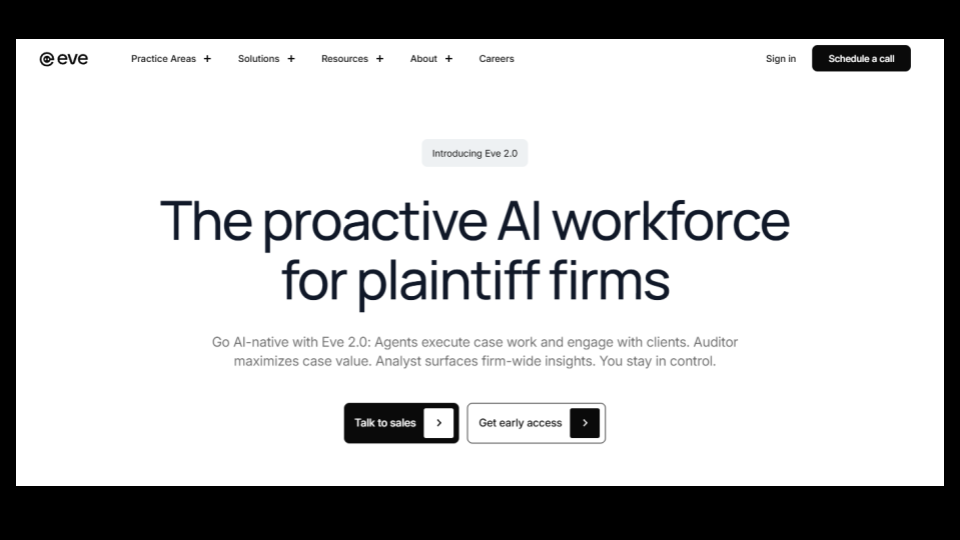


Amid the ongoing debate over whether AI will replace lawyers, the legal tech company Eve is offering a different answer: It won’t replace them, but it will autonomously handle much of the routine work they used to do themselves, to give them more time for higher-value legal work.
The company has unveiled Eve 2.0, which it says represents a fundamental reimagining of how plaintiff law firms staff and deliver legal work.
Rather than offering passive software that requires constant human prompts, Eve is deploying what it calls a proactive AI workforce that plugs directly into a firm’s organizational chart to handle execution, review and intelligence — all autonomously.
The release introduces three distinct AI-powered roles: AI agents that execute routine case work, an AI auditor that continuously reviews every document for quality and missed value, and an AI analyst that surfaces firm-wide intelligence and growth opportunities.
“Plaintiff firms don’t hit a ceiling because they lack cases; they hit a ceiling because human execution is hard to scale,” said Jay Madheswaran, Eve’s CEO and cofounder, in announcing the release. “The traditional law firm pyramid is broken. It traps your best legal minds in administrative noise. Our new release fixes the org chart by inserting an AI execution layer at the bottom.”
Related: LawNext: Eve CEO Jay Madheswaran on Building AI-Native Law Firms for the Plaintiffs’ Bar.
In other words, AI won’t replace lawyers, but it will take over the tasks that keep lawyers from being lawyers — the document chasing, the deadline tracking, the routine drafting, the quality checking. What remains is the work that actually requires legal judgment, strategy and client relationships.
Three Distinct AI Roles
Eve 2.0 is organized around roles rather than features, mirroring a traditional law firm’s organizational structure:
- AI Agents act as digital associates that monitor case activity and take action automatically. When medical records arrive, Agents summarize them. When deadlines approach, Agents draft required documents. They also manage routine intake, status updates and scheduling. All work is queued for attorney review and approval before leaving the firm.
- AI Auditor serves as an always-on senior review layer, examining every document in every case to flag missed deadlines, overlooked injuries, factual gaps and risk exposure — when issues can still be corrected and value preserved.
- AI Analyst operates at the firm level rather than the case level, connecting patterns across an entire docket to surface operational bottlenecks, performance differences between teams, and which referral sources, case types, and workflows drive the strongest returns.
The company describes the product as creating an infinitely scalable “hybrid workforce” where AI handles routine work and continuous review, while attorneys retain control of strategy, judgment and advocacy — in other words, all the work that actually requires a law degree.
In this way, Eve says, the product addresses the fundamental labor bottleneck that limits plaintiff firm growth.
“For decades, plaintiff firms have operated under a labor-intensive model where attorneys initiate every task, chase down records and manually double-check work as cases progress,” the company says. “As caseloads grow, this approach creates bottlenecks, increases risk and pulls experienced lawyers away from higher-value legal judgment.”
Eve replaces that bottleneck with what it calls “an elastic, AI-native layer that scales infinitely,” handling the groundwork so attorneys can focus on being attorneys.
Momentum Building
The announcement comes at a time of significant growth for Eve. The company says it has achieved 10x revenue growth over the past year and now serves more than 500 plaintiff firms, including Ricci Law, Smith Clinesmith LLP, Jeffrey Glassman Injury Lawyers, the Law Offices of James Scott Farrin, and Mike Morse Law Firm.
In September, Eve announced a $103 million Series B financing at a valuation exceeding $1 billion, led by Spark Capital with participation from Andreessen Horowitz, Lightspeed Venture Partners, and Menlo Ventures. That followed a $47 million Series A round last January.
When I interviewed Madheswaran for the LawNext podcast last March, he described Eve’s mission as transforming traditional plaintiffs’ firms into “AI-native law firms” — not just automating tasks but fundamentally changing how legal services are delivered by encoding firms’ unique knowledge and processes into intelligent systems.
With this latest release, that vision appears to be taking concrete form. Rather than waiting for attorneys to prompt the system, Eve now proises to become an autonomous layer that continuously advances cases, reviews work and generates insights — with human attorneys stepping in to review, approve and make strategic decisions.
In short, this latest release is not about replacing lawyers. It’s about replacing the work that prevents lawyers from doing what they were trained to do.