 Robert Ambrogi Blog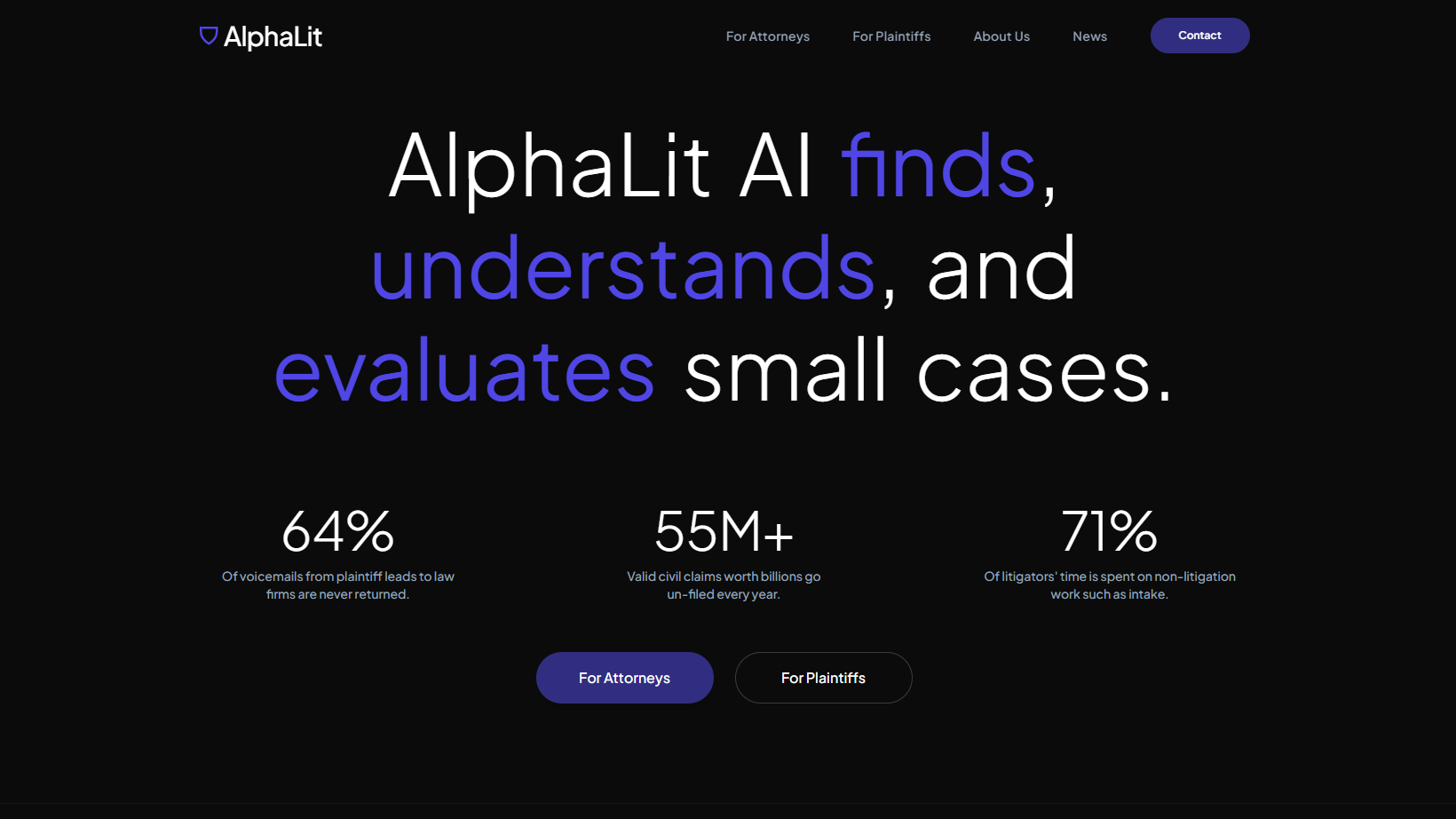


Over $55 million worth of meritorious civil claims go unfiled annually, particularly in working-class communities, because over 64% of prospective plaintiffs’ calls to law firms are ignored, says legal AI startup AlphaLit.
The reason firms ignore those calls is that they cannot financially justify vetting all those small cases. “You might need to have 100 conversations to take on five or six cases,” says AlphaLit founder and CEO Anand Upadhye. “That doesn’t pencil.”
Aiming to use AI to solve this problem for smaller cases and smaller law firms, AlphaLit said today it has raised a $3.2 million seed round.
Participants in the round were venture capital firms Lux Capital, Slow Ventures and Bright Ventures, alongside several angel investors, including Ken Cornick, the cofounder of CLEAR, and Jason Boehmig, executive chair and cofounder of Ironclad.
They join previous investors including Sequoia Scout Fund, Base Ventures, and Casetext co-founder Jake Heller.
Scoring Smaller Cases
AlphaLit tackles this problem through a combination of voice AI and algorithmic case scoring.
When prospective plaintiffs engage with AlphaLit’s voice AI platform, it interviews them to understand their issue, evaluates their evidence against legal frameworks, and then drafts a case memo.
Using its proprietary algorithms, the company assigns each case an AlphaLit score, which is based on liability, evidence quality, and potential damages. If the score reaches a certain threshold, AlphaLit engages with the plaintiff and sends the case to an attorney in its network.
Already, the company has created some 80 cases through its platform. It is operating only in California for now, and only for employment-related cases, but it plans to expand both the types of cases it handles and the jurisdictions it covers.
“Unless your case is worth millions or you are well-connected, it’s almost impossible to get a lawyer on the phone,” said Upadhye. “By using AI to handle the heavy lifting of intake and fact-gathering, we are lowering the cost of pre-litigation and opening legal access for millions of Americans.”
Solving the Small Case Problem
For attorneys in smaller law firms, AlphaLit helps them get over three major obstacles that make it too expensive for them to accept smaller cases, Upadhye told me in an interview:
- Marketing and advertising. Marketing can be complicated and costly, especially for smaller firms that lack marketing staff. AlphaLit does the marketing for them.
- Intake. Intake can be time-consuming and difficult to schedule, especially for plaintiffs who work during the day. The actual intake process often requires specialized staff and specialized expertise. AlphaLit’s voice AI platform handles all the intake and delivers a case memo.
- Evaluation and underwriting. Even after the prior steps, an attorney needs to evaluate the case and decide whether to take it on. AlphaLit’s algorithm performs that evaluation, only referring cases that meet a threshold.
In a statement provided by AlphaLit, Peter Hebert, partner and co-founder at Lux Capital, said: “AlphaLit is attacking a massive, latent market. The legal industry has struggled with the economics of high-volume, lower-dollar claims. Anand and his team have built the technical infrastructure to turn these overlooked claims into a viable, scalable asset class.”
Before founding AlphaLit in 2024, Upadhye was director of investments at the litigation funding company Legalist. Earlier, he was vice president of business development at Casetext, before it was acquired by Thomson Reuters.
“We are a mission-driven company,” Upadhye told me, aiming to make a meaningful impact on the number of people who are protected under the law.”