 Robert Ambrogi Blog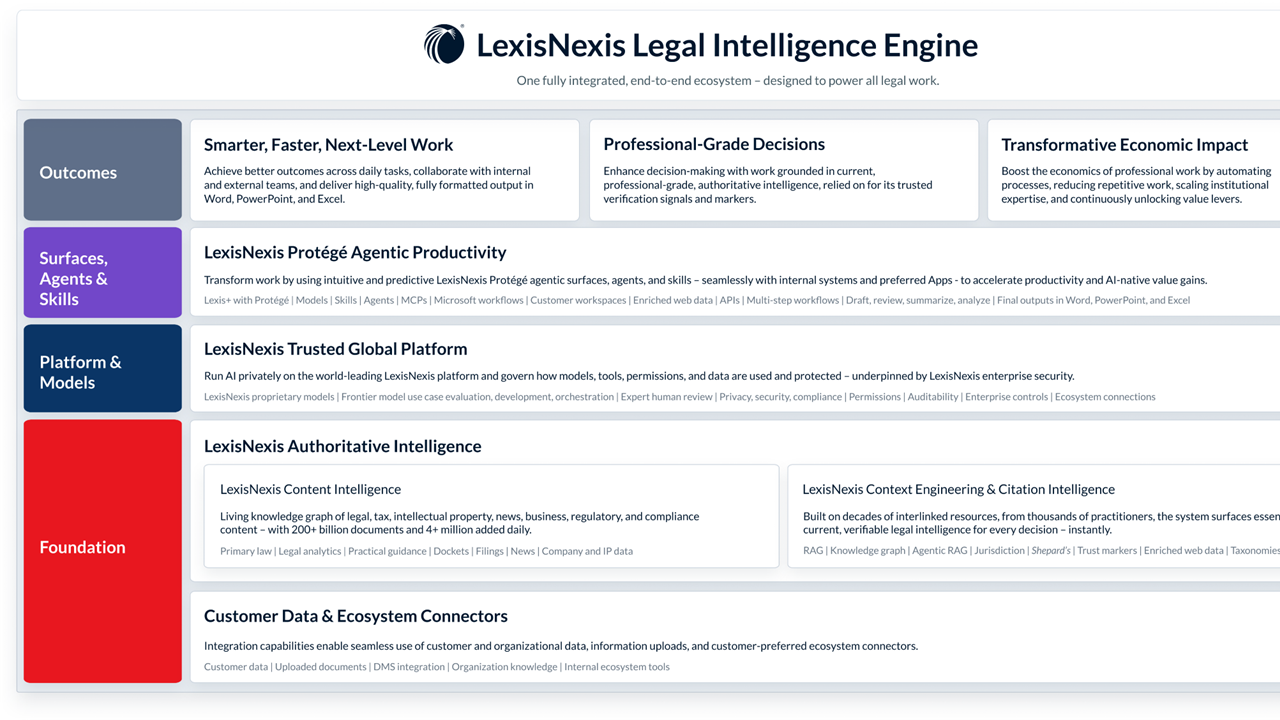


LexisNexis Legal & Professional today announced what it is calling the next generation of Lexis+ with Protégé, its generative AI legal assistant, unveiling new agentic capabilities designed to enable legal professionals to move from an initial idea to review-ready work product in one intuitive AI experience.
Branding it the LexisNexis Legal Intelligence Engine, the release centers on a new orchestration layer, or “harness,” that dynamically selects and coordinates AI models, agents, skills and content sources based on the task a user describes, rather than routing requests through predefined workflows as the platform previously did.
The practical effect, the company says, is that a legal professional can describe what they want to accomplish and receive review-ready output in Microsoft Word, Excel or PowerPoint, with the system deciding behind the scenes which models, tools and sources to apply, all while carrying context forward from one step of a matter to the next.
“It’s really creating an ecosystem bringing together all of our content, all of our capabilities, and the customer data, with a much more intelligent engine, which is why we call it the Legal Intelligence Engine, because it seamlessly brings all of this together,” Jeff Reihl, executive vice president and chief technology officer, told me in a briefing last week.
A Dynamic Harness
The key change in this new release from the company’s prior agentic platform is the harness architecture, Reihl said. In the platform’s prior version, workflows were scripted in advance.
“The agentic capabilities we had before were much more predefined,” Reihl said. “So if you’re going to create a brief, it followed very specific steps that were predefined.”
The new platform, he said, “can bring in additional tools, it can bring in additional information, and it can check its work and then loop back and redo it” if it determines the output does not fully answer the request.
Before executing a plan, the system presents it to the user, allowing the user to modify it, such as by correcting a jurisdiction adding or removing data sources. It then shows its work at each step, indicating what data it is drawing on and where each piece of a drafted document comes from.
The harness can draw on content from across the LexisNexis portfolio without requiring the user to switch products. The system can, for example, pull in judge analytics from Lex Machina, SEC-related research from Intelligize, and current news from Law360.
Of course, it also draws from the company’s core body of more than 200 billion documents and can draw from a customer’s own documents in a connected document management system.
Legal search and web search, which were previously separate functions, are now unified, with the system also validating citations returned from web results.
In our briefing last week, Alexandra Smyth, executive vice president and general counsel of LexisNexis, said the change eliminates the tool-switching that previously characterized multi-source work.
“If I’m working on something around the SEC, in the past I would have done drafting in one bit, done some research in Intelligize, and put it back,” she said. “Now it all does it in the one place. … It knows to jump between the two on its own.”
Among the new capabilities Reihl described is Shepard’s Verify, which extends the company’s long-standing citation service into the drafting workflow. Beyond confirming that a cited case is accurate and still good law, Reihl said, the feature also validates that the case is relevant to the specific task at hand.
When I asked whether a lawyer could now hand the system an opponent’s summary judgment motion, go get a cup of coffee, and return to a finished responsive brief, Smyth said the reality is “somewhere between the two.”
A user can set the system off on the task, she said, but must still review the result. “Every regulator in the world that’s commented on this has said you’re still responsible for what you file,” she said.
Reihl added that a user could first direct the system to analyze the opposing brief, assessing the strength of its arguments and validating its citations, before prompting it to draft a response.
Skills and Memory
The platform now includes several hundred skills, which are packaged instructions for specific document types, briefs and client communications. Reihl said LexisNexis has also incorporated skills from Anthropic’s Claude Legal offering.
Firms can customize the default skills and will soon be able to create their own skills and workflows.
This new version also introduces memory, meaning that the system remembers the context of what happens during a session.
“So if you look at Lex Machina, and you bring that forward and you look at a particular judge, it remembers that and it can bring that into later parts of the conversation,” Reihl said.
In later versions of the platform, Reihl said, it will be able to remember even more, including documents you have created in the past and your preferences.
“It knows that you’ve worked on a case similar to this three months ago, that you’ve used other cases related to this particular legal area and it’ll remember and bring that stuff in,” he said.
As to the LLM models underlying all this, the company says that Lexis+ with Protégé applies the model best suited for each task by default, while allowing users to select a preferred model.
The company also said that it will preview its own models later this year. In our briefing, Reihl offered some context on that effort.
In the past, he said, the company fine-tuned models, including a fine-tuned version of Mistral, and invested substantially in reinforcement learning with Anthropic as early as 2023, with results that “didn’t move the dial” relative to the cost.
With better base models and the new harness architecture, he said, the company is “going to take another shot at it,” describing the current work as evaluation and testing.
“We’re pretty certain we’ll have some customized models,” he said, “but just how far we go with the reinforcement learning and using our content” remains to be seen.